DVARA 1.8.0 — Govern models, tools, and agents

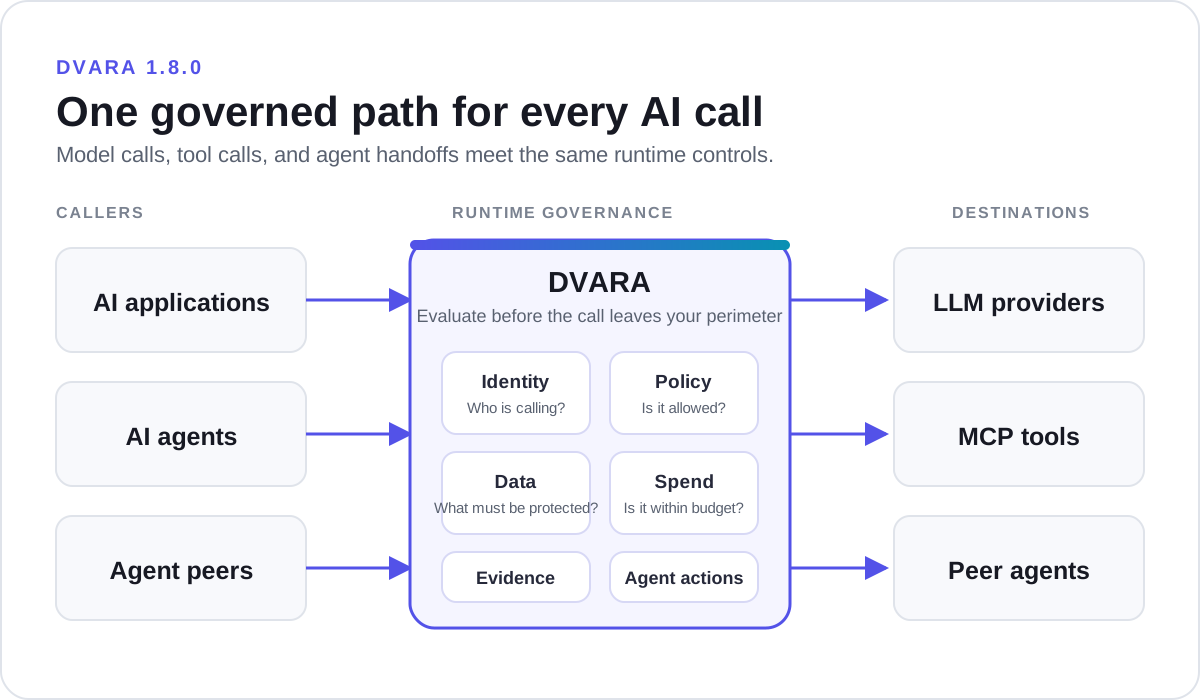
AI applications rarely stop at one model call. They call different providers, use tools through MCP, and increasingly hand work to other agents. Each hop is a place where policy, data, spend, or evidence can fall apart.
DVARA 1.8.0 puts those calls on one governed path. It introduces a clean Open Source foundation for LLM traffic and strengthens the Enterprise controls used across models, tools, and agents.
Start with Open Source
DVARA Open Source is an Apache-2.0 LLM Gateway that runs with file configuration and no database. It gives you a practical way to put policy, PII checks, guardrails, rate limits, and a local tamper-evident audit file in front of model traffic.
You can run it as a standalone gateway or embed its governance libraries in a
Spring Boot application. The configuration lives in gateway.yaml, so the
first deployment is easy to inspect, version, and reproduce.
The Enterprise platform builds on the same foundation. It adds Flightdeck, central persistence, fleet operations, advanced LLM controls, and the DVARA MCP and A2A Gateways.
Make permissions real
API-key scopes are now enforced across the LLM, MCP, and A2A planes. A key can be limited to the operations its workload needs—for example, model discovery, embeddings, MCP reads, tool calls, or A2A sends.
A valid key used outside its scopes is refused with 403. That turns scopes
from descriptive metadata into an authorization boundary.
Say exactly what happens to sensitive data
In 1.8, REDACT and TOKENIZE mean different things:
| Action | What happens |
|---|---|
LOG | Record the finding and leave the value unchanged. |
BLOCK | Refuse the request. |
REDACT | Replace the value irreversibly. The original is not stored. |
TOKENIZE | Replace request-side data with a reversible token when the Enterprise token store is available. |
The distinction matters. A compliance review should not have to guess whether “redacted” data can later be recovered.
Hold protected streams until the decision is final
An observational streaming policy can still deliver events immediately while DVARA records evidence. A control that can block or transform content now holds the complete response, makes one decision, and then releases governed content or refuses it.
DVARA also treats a provider stream that ends without a finish reason as an error. A truncated answer no longer looks like a successful, billable response.
Govern tools and agent handoffs
The Enterprise MCP and A2A Gateways apply the same identity, policy, PII, budget, approval, loop-detection, and audit controls to tool calls and agent handoffs.
Streaming LLM tool calls now retain their IDs, types, function names, and arguments through provider translation. DVARA records the intent; your application still decides whether to execute the tool.
Give operators evidence they can use
The release adds clearer operational signals around refused requests, protected stream buffers, incomplete streams, webhook delivery, cluster membership, and provider failures. File-backed audit chains can be verified with coverage as well as a pass/fail result.
Provider failures are also classified more carefully. A bad key or most other
provider 4xx responses no longer open a shared circuit for every workspace.
Rate limits, timeouts, and fallback behavior now follow the reason for the
failure instead of treating every error alike.
Read this before upgrading
Several controls that were previously permissive or inactive now take effect. Check these before moving production traffic:
- A non-empty API-key scope list is enforced.
REDACTis irreversible; useTOKENIZEwhen you need reversible request-side substitution.- Tool allowlists and denylists now match and enforce their rules.
- Context limits come from the serving provider, and the maximum-input-token guardrail is off by default.
- Provider
4xxresponses other than408and429do not count against the shared circuit breaker.
The 1.8 upgrade guide covers the complete preflight, rollout, verification, and rollback sequence.
Try DVARA 1.8
Download the Open Source 1.8.0 release, follow the Open Source quickstart, compare capability availability, or book a walkthrough for the Enterprise platform.