SDK & Framework Integrations
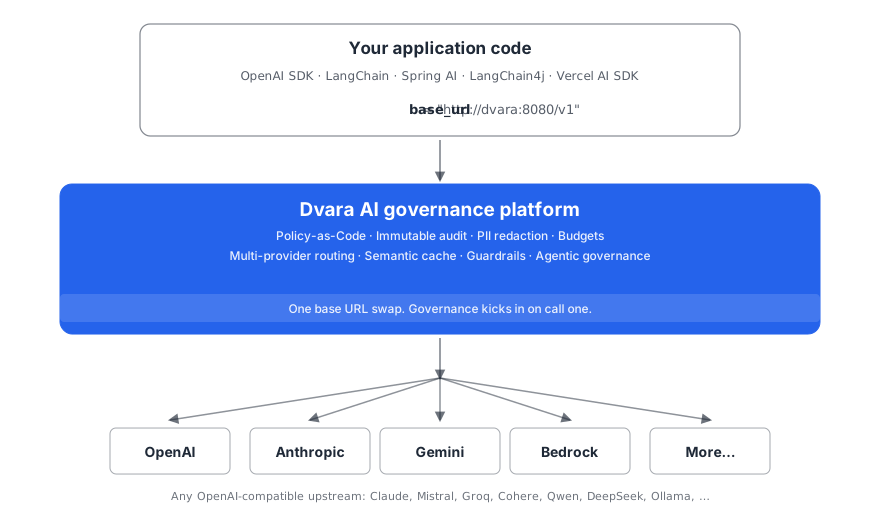
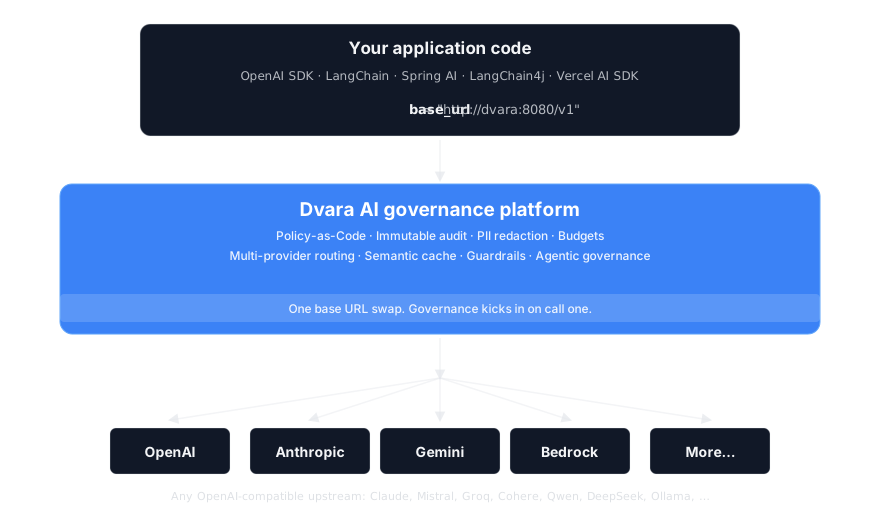
DVARA is an AI governance platform — Policy-as-Code, tamper-evident audit, PII redaction, agentic governance, and cost attribution under one control plane — with a fully OpenAI API-compatible data plane. Any SDK or framework that supports the OpenAI chat completions API works with DVARA by pointing at the gateway's base URL. No custom SDK required, and governance kicks in on the first request.
Pick your language
Jump to the integration guide for your stack — every page shows the full round-trip (request + response + observable effect in the DVARA Flightdeck):
- Python SDKs — OpenAI, Anthropic, AWS Bedrock, Google GenAI, LiteLLM, LangChain, Pydantic AI
- JavaScript / TypeScript SDKs — OpenAI JS, Anthropic JS, Vercel AI SDK
- Java SDKs — OpenAI Java SDK, Spring AI, LangChain4j
- Additional OpenAI-compatible providers — long-tail providers that aren't built in as first-class translators: Fireworks AI, Together AI, Perplexity, vLLM hosts, ERNIE / Wenxin, and any future OpenAI-compatible upstream. (Qwen, DeepSeek, Moonshot, ChatGLM, and Grok are first-class — see the full provider list on the additional-providers page.)
- DVARA-specific headers —
X-Trace-ID,X-Session-Idfor correlation across SDKs - Migration guide — moving from direct provider access or another gateway
- Troubleshooting — common 4xx / 5xx errors and their fixes
- Spring Boot governance engines — call DVARA's Open Source policy, PII, and guardrail engines from your application without adding routes
- Embedded Spring Boot Gateway — serve DVARA's OpenAI-compatible
/v1API from your application - Claude Code — point Claude Code at DVARA's Anthropic Messages API (
/v1/messages, from 1.8.5) so every model call it makes is governed - Codex CLI — point Codex CLI at DVARA's Responses API (
/v1/responses, from 1.9.0) - Gemini CLI — point Gemini CLI at DVARA's Gemini
generateContentAPI (/v1/gemini, from 1.9.0) - GitHub Copilot — VS Code Copilot Chat and agent mode, and Copilot CLI, through Copilot's bring-your-own-key settings (from 1.9.0)
- OpenCode — add DVARA as an OpenAI-compatible provider
- Cursor (preview) — Cursor's custom OpenAI base URL, at
/v1/cursor
Quick reference
The only change any of these SDKs need is the base URL. Everything else — the request shape, streaming semantics, tool-calling, structured output — stays the same.
| SDK / Framework | Language | Config change |
|---|---|---|
| OpenAI SDK | Python | base_url |
| OpenAI SDK | JavaScript / TS | baseURL |
| OpenAI SDK | Java | .baseUrl() on the client builder |
| Anthropic SDK | Python | base_url + model prefix |
| Anthropic SDK | JavaScript / TS | baseURL + model prefix |
| AWS Bedrock SDK | Python | Switch to OpenAI SDK |
| Google GenAI SDK | Python | Switch to OpenAI SDK |
| LiteLLM | Python | api_base |
| LangChain | Python | openai_api_base |
| Pydantic AI | Python | base_url on OpenAI provider |
| Vercel AI SDK | JavaScript / TS | baseURL on createOpenAI() |
| Spring AI | Java | spring.ai.openai.base-url |
| LangChain4j | Java | .baseUrl() |
| Additional providers | any | Register a custom provider + OpenAI SDK base_url |
| DVARA engine starter | Java | Add governance engines without HTTP routes |
| DVARA Gateway starter | Java | Add the governed /v1 API to the host application |
| Claude Code | CLI | ANTHROPIC_BASE_URL + a DVARA key, from 1.8.5 |
| Codex CLI | CLI | A model_providers entry in config.toml, from 1.9.0 |
| Gemini CLI | CLI | GOOGLE_GEMINI_BASE_URL + a DVARA key, from 1.9.0 |
| GitHub Copilot | VS Code, CLI | A Custom Endpoint model, or COPILOT_PROVIDER_*, from 1.9.0 |
| OpenCode | CLI | An @ai-sdk/openai-compatible provider |
| Cursor (preview) | IDE | The OpenAI base URL override |
Prerequisites
All examples on the language pages assume:
- DVARA is running at
http://localhost:8080 - A workspace and API key have been created (see Quickstart)
- The target provider is configured in DVARA (e.g.
OPENAI_API_KEYset)
Replace your-dvara-api-key with your actual DVARA API key throughout.
Supported endpoints
Every request from every SDK ultimately lands on one of these public Data Plane paths. The OpenAI-compatible shape means any SDK that speaks POST /v1/chat/completions on the vendor endpoint works against DVARA without change.
| Endpoint | Purpose |
|---|---|
POST /v1/chat/completions | Chat (all models, streaming, tools, structured output) |
POST /v1/completions | Legacy text completion (wraps chat internally) |
POST /v1/messages | Anthropic Messages API, from 1.8.5, for Claude Code and the Anthropic SDKs. Governed like chat. POST /v1/messages/count_tokens counts tokens without calling a model. See Claude Code. |
POST /v1/responses | OpenAI Responses API, for Codex CLI and other agents built on it. Your own tools, from 1.9.0; built-in tools are refused. See Codex CLI. |
POST /v1/gemini/v1beta/models/{model}:generateContent | Gemini's generateContent API (and :streamGenerateContent, :countTokens), from 1.9.0, for Gemini CLI and the Google GenAI SDKs. See Gemini generateContent API. |
POST /v1/embeddings | Embeddings — used by RAG pipelines and semantic search |
GET /v1/models | Best-effort model discovery with provider-declared capabilities; see Provider Setup |
POST /v1/budget/estimate | Enterprise pre-flight check for a model and max_tokens. Returns estimated output cost, current remaining budget, and would_exceed_budget without calling a provider. |
POST /v1/webhooks/actions/{action} | Approval-gate callback for MCP human-in-the-loop flows. Not called from the OpenAI SDK — receives a signed token from an approver clicking through a webhook link. Listed here for completeness. |
Full request and response schemas, along with a Try it panel that executes
real calls against a DVARA instance, live in the Data Plane API
reference.
Manage workspaces, routes, policies, budgets, and credentials in the DVARA
Flightdeck. For reviewed bulk changes, use GitOps export and
import. The former Automation API was removed in
1.7.0, so Terraform and CI jobs must not call /v1/admin/** CRUD routes.
Observability endpoints
These are separate from the request path. Every DVARA instance exposes them so your monitoring stack can scrape health and metrics:
GET /actuator/health— Liveness summary (anonymous; good for liveness from any SDK). Sub-paths/actuator/health/livenessand/actuator/health/readinessare also anonymous, intended for Kubernetes probes.GET /actuator/info— Build info (app.*,build.*); also anonymous, useful for version discovery.GET /actuator/gateway-status— Gateway runtime status, providers, routes, limits, region, and warnings. RequiresAuthorization: Bearer $DVARA_ACTUATOR_API_KEY; it does not return licence or posture fields.GET /actuator/license— Enterprise Gateway posture and licence health. Requires the same operator bearer and is absent from the Open Source distribution.GET /actuator/prometheus— Prometheus scrape endpoint. RequiresAuthorization: Bearer $DVARA_ACTUATOR_METRICS_API_KEY, which must differ from the operator key.
Why route through DVARA
Drop-in OpenAI compatibility means governance kicks in on call one — point any OpenAI SDK at DVARA and every request is:
- Policy-evaluated — YAML-defined policies run before the upstream call (see Routes & Policies)
- Audited — every request and response writes to the tamper-evident, HMAC-signed audit trail
- PII-protected — sensitive spans can be blocked, removed irreversibly, or
tokenized for controlled recovery before leaving the perimeter;
LOGis the default and changes nothing - Cost-attributed — per-workspace, per-model, per-API-key spend tracked for chargeback
- Routed — multi-provider failover, latency-aware routing, cost-aware routing
- Cached — semantic cache for repeated queries
All of this is transparent to your SDK code. You change one line.